The Functional Flat in Friedenau
Leyzer Ber
In this instalment of the Wirklichkeit Books Newsletter investigative journalist and documentary filmmaker Leyzer Ber remembers a “comparatively uneventful moment of transition” in his life that took place in a so-called functional flat in Friedenau. Enjoy! And let us know what you think.
***
The esoteric theory of “ley lines” posits the existence of mysterious connections between distant parts of the Earth with supposedly significant energies. These straight lines apparently criss-cross the planet, linking together the usual suspects—the Pyramids of Giza, Stonehenge, the Bodhi Tree. As good materialists, we’re not supposed to believe in ley lines. What are they even made of, anyway? Who or what has determined their direction and their connections? Do the lines all meet up at one place or another? Who says they need to be straight? Who knows.
What, however, we can be sure of, is that Berlin sits at the site of the most remarkable energetic loci: there is Kotti, the black hole at centre of the universe, irresistibly pulling all into its gravitational vortex; and Südblock, the bar at the centre of the universe. You also have the mystical line tying the ethnically cleansed village of Deir Yassin, now a mental health clinic in West Jerusalem, to the office of the Beauftragter der Bundesregierung für jüdisches Leben in Deutschland und den Kampf für Anti-Antisemitismus Felix Klein; and, last but not least, there is the little known but quietly momentous invisible funicular, which once upon a time set off from Plaza Baquedano in Santiago de Chile, heading north to the Bolivian capital La Paz, from whence it shot vertiginously upwards until it reached the plateau of El Alto, and then curved a track along the Andes, passing through Aymara, Quechua, and numerous other indigenous territories, stopping off in the Free and Sovereign State of Chiapas before hopping over the Atlantic, making a short detour via Bielefeld and reaching its final destination, at the funktionale Wohnung in the bourgeois Altbau on Friedenau’s Rheinstrasse - aka “Rheini”.
What on Earth was Rheini, the funktionale Wohnung? Peel the layers of stickers off the walls, take down the Wiphala, and you might be able to make out what should have become of this apartment: the home of two well-fed, high earning parents, their three, perhaps four well-fed, well-clothed children, each with their own bedroom, their beloved dog, their beloved cat, and a lifetime of enforced familial bliss.
Into this space, however, came together a fluctuating motley crew, at any time ranging anywhere from ten to twenty flatmates. Some were migrants from Latin America, others, Germans with Latinohintergrund, or Germans who had lived for some time in Latin America—Spanish and Portuguese mixing freely with English and German. The origin stories of the funktionalistas were varied: the children of Communist guerrillas who had fled the Latin dictatorships mingling with the children and grandchildren of Zionist and Nazi war criminals.
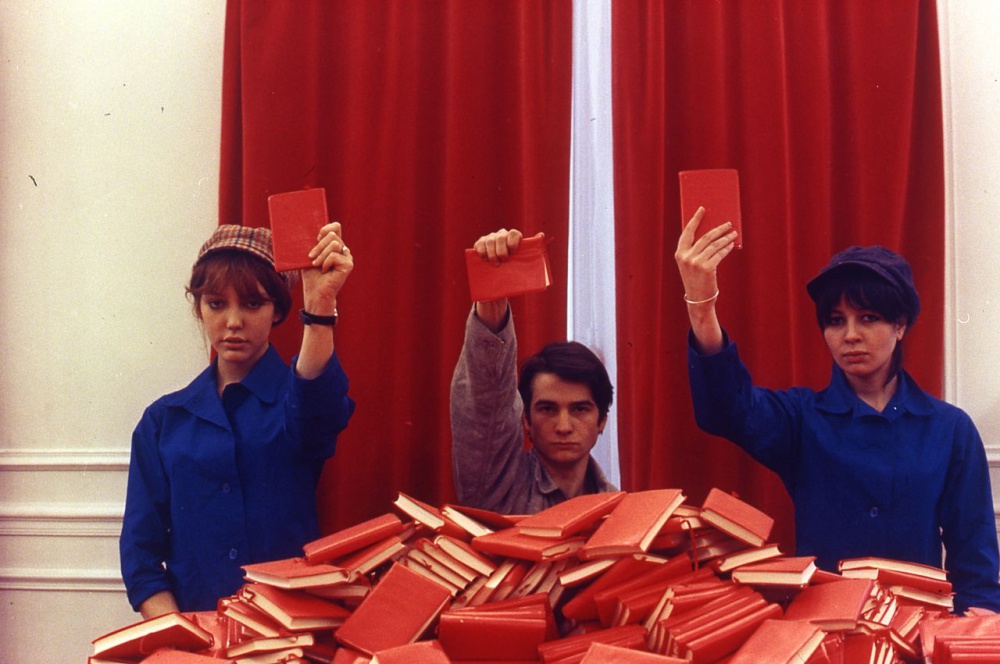
The ‘funktionale’ refers to the ‘Funktion’ of each room: the bedroom where everyone slept together in a comradely polycule, the wardrobe with everyone’s clothes jumbled up, the working room with everyone’s thoroughly worn copies of Venas Abiertas, the living room with views over Breslauer Platz, and the pokey little kitchen which, to my eternal frustration, also served as Rheini’s smoking room. The funktionale Wohnung, blending elements of an old-school Berliner squat, a backpackers’ youth hostel and the Maoist commune in Godard’s La Chinoise.
Speaking of which… every other Sunday, Rheini’s living room was the meeting place of a Salon: the so-called “Untitled Political Process”. The topics of discussion swirled around the parlous state of “The German Left”. These so-called “Leftists” who quoted Adorno all wrong, or the wrong Adorno, who had never passed through Qalandia checkpoint (or, if they had, had done so using the Express Lane), and had not done their Masters at SOAS. Something had to change.
I, however, had come to Rheini not to discuss political organising, but for a brief and, let’s say comparatively uneventful moment of transition in my life, in true Berliner neo-Bohemian style. Every day, I’d wake up with a hit of hash from my scrappy DIY apple pipe (“der Geist des Apfels”), then lumber towards the Stadtbad in Schöneberg to splash about for a bit, enjoy my belated breakfast Gemüsekebap at Rüyam’s, finally arriving a few hours later at cuccuma café in Bergmannkiez where I read books by Bifo Berardi and studied some fus7a in that awkwardly arranged upstairs area, alongside groups whose conversations would reverberate around the room, disrupting my half-baked readings. The conversations of others would always annoy me, but it never occurred to me that I could just go instead to the library. The Rheini-cuccuma pipeline had to be followed to its final destination.
The daily grind in Rheini was much like in any other shared flat—simmering resentments over who hadn’t fulfilled their cleaning chores; the patient tolerance towards that one flatmate with the mental health crisis; and that other flatmate for whom everything was revolutionary, or not revolutionary enough. What was meant by “revolutionary”, I could never quite tell.
It’s been many years since I went to Rheini, I don’t have any reason to trek down to Friedenau anymore. Nobody seems to know if it even still exists. Perhaps new generations of misfits and refugees are cramming into the kitchen reeking of tobacco and cannabis, improvising neo-jazz in the music room or plotting to sabotage weapons factories in the living room. Or maybe the landlord finally figured out what was going on and kicked the Latins out, to jack up the rent and bring in some expats and their aforementioned familial bliss.
Little is known of what happened to Rheini, but tiny little shards bearing the Rheini spirit have been known to wash up in all sorts of places, in El Bloque Latinoamericano and Migrantifa, in Pachakuti, in Ararat, on Copacabana Beach, in Jewdas, in Rojava, in Inti Phajsi, and even in Qatar, to name just a few examples.
***
Leyzer Ber is a wannabe Hungarian-Brazilian and post-Jewish investigative journalist and documentary filmmaker.