Redacted: A Portrait
By Alexandra Symons Sutcliffe
Alexandra Symons Sutcliffe, a London-based art historian, is the author of the third edition of the Wirklichkeit Books Newsletter. Her writing revolves around the functions, desires, and forms of violence in photography. As a former resident of Berlin, in Redacted: A Portrait, she looks at the city from afar through the image of an old friend who has become a figure within the current crisis of German national identity.
***
All love is found in the face. The cheeks, the lips, not the pout but the break in the mouth’s line, the interruption of a surface’s serenity. One snaggletooth, a constellation of freckles, a map of adoration. At the centre of any portrait are the eyes: eyes that look back seduce or accuse, eyes that look away refuse permission.
Photography moves between two poles, pleasure and discipline. The face of the subject is a site of romantic fixation, familial longing, and a nexus of surveillance—recorded, categorised, and claimed by an archive of criminal types. But the criminal and the lover may be one and the same, and they share only one face. This is the seam we call identity.
Earlier in the year an old friend of mine was made an enemy of the German state. I was shocked to look down at my screen and find him reframed and marked as outside the bounds of national interest. This old friend of mine has always been beautiful. He has the jaw of a man who fought and won wars. Hard, full, tempting disaster. The top bow of his lip is supple to the point of collapse, like a cut rose standing in water. Watching his image proliferate, across the news and through social media, I thought: Europe is in bloom.
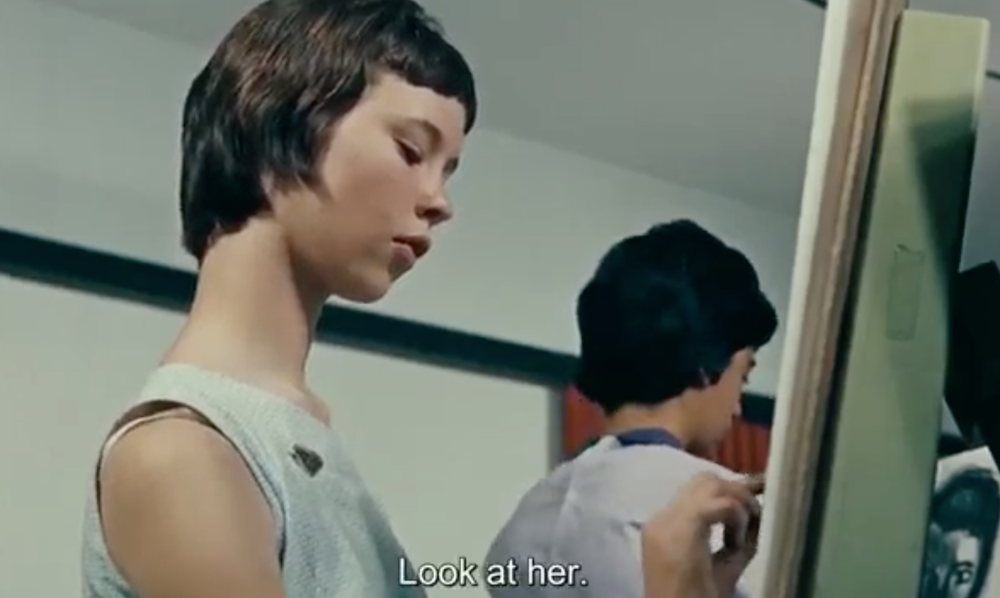
We used to live in London. Sometimes we’d go to the cinema together, sometimes in the middle of the day, like you can when you’re young. One hot August over ten years ago—when the United Kingdom was still part of the European Union, and we were still friends—we saw a 16mm projection of Chris Marker’s Description of a Struggle (1960).
“Signs. The land speaks to you in signs.” The translated subtitles read, stamped across still photographs and moving images. Portraits and documentary footage, daily life in Israel, both Palestinians and Israeli Jews. Then archival film of the clearances of the Nazi camps, the arrival of Europeans into the British Mandate. “Signs of land. Signs of water. Signs of man.” The voice continued.
Marker won the Golden Bear at the Berlin Film Festival in 1961, but the print we saw was poorly cared for, chemically corroded in its can, the image turned a smarting sci-fi magenta. The curator assured the audience it was the best they could do and might even be better this way.
In the final scene Marker’s camera circled a school art class. “We must watch her,” the voice declared over footage of a young girl. Her neck was long, swan-like, the face of a doll. She might have been twelve, the same age as her nation, a civilization-ending beauty. “Look at her,” the voice demanded again. “Miracles die with their witnesses.” In the London cinema she was tickled pink by the mould that grew in the film can. In Israel, she had become an old woman. In London, she remained a budding girl.
Seeing my old friend at the centre of a political campaign, I didn’t contact him. Instead I looked online for the Marker film. It’s been restored and digitized. The rosy tint dabbed away and the original vision of the filmmaker repaired. Now we see the colours that Marker’s camera made, without the stains of time and neglect. We see how he sequenced his subjects into history’s continuity. We see how beauty is transient.
Riffling through a box of old papers I find myself decapitated. Photos taken for a passport, cut off at the neck, bleached-flat, cleared for work and travel. The portrait isn’t needed: with the implementation of biometric data systems, the face has been made superfluous. It remains only as an anchor and specimen. I put the spare prints back, along with the ones of my parents and grandparents: black and white, sunglasses on, smoking in the photobooth. With my hands in the box, I say: your sentimentality is a shield against abstraction.
The face is the site where intimacy and power coincide. The camera enforces proximity, reading every line and hair as detail rather than relation. The portrait is structured as a redaction. Without the promise of future meaning, private wounds are scaled to history, an archive of infinite, anonymous flesh. This is not the end of eroticism but its indefinite suspension, administered by photography.
Alexandra Symons Sutcliffe is an art historian, writer, and curator. She is currently completing a PhD in British documentary photography at Birkbeck, University of London.
***
On another note, Dagmar Herzog’s The New Fascist Body / Der neue faschistische Körper is covered widely in both English and German press: Curator Susanne Pfeffer includes the book in her Best of 2025 list for Artforum, Molly Young recommends it in GRANTA, Hanno Hauenstein talks with Dagmar Herzog in his podcast NULLPUNKT (English translation here), and even Die Welt publishes a conversation with the author (read our comment on Die Welt coverage here).