Artists, Entrepreneurs or Workers? An episode of collective action in the book industry
Ramiro Mases
In this issue of the newsletter, we are dealing with the political side of publishing for the second time. Our colleague, comrade and friend Ramiro Mases, co-founder of the publishing house Rara Avis in Buenos Aires, reports on the significance of the book law in an escalating political crisis. Rara Avis’ collective founding of the cooperative TyPEO and its success is an encouraging example at a time when right-wing interference in the book industry is also becoming a political issue in Germany. As always, we look forward to hearing your thoughts.
***
On December 27, 2023, some days after taking office, Javier Milei’s government publicly presented a 664-article bill called “Ley de Bases” that sought to modify more than 38 existing laws and decrees. It was a de facto constitutional reform aimed at creating the legal and material conditions to completely deregulate the economy and the administration in favor of concentrated oligopolies, transferring wealth from the poorest to the richest, and weakening Argentina’s territorial, political, and cultural sovereignty as much as possible. Among the dozens of laws and decrees which it sought to modify was the elimination of the so called Book Law (“Ley 25.542”), arguably the very reason for the existence of the extremely diverse, longstanding, and well established world of books in Argentina – besides being a landmark of industry-wide consensus at the time of its enactment. In other words, this regulation, which establishes a single retail price for each title set by the publisher for the entire national territory and limits the discounts for direct sales, enabled Argentina to become an epicentre for Spanish-language book publishing.1 An ecosystem of independent bookstores, local book fairs, and small projects throughout the country followed, radiating outward from Buenos Aires into smaller cities. From this flourished an even richer publishing landscape made up of publishers ranging from mega-transnational groups to one-person artisanal projects; including university, municipal, union and hundreds of independent presses that publish professionally while preserving the idea of being a publisher as a vital and aesthetic action. With the repeal of this law, included in the reform proposed by Milei’s government, the path for a total deregulation of the book market was paved. The provisions would encourage the economic concentration of sales in bookstores with large warehouses, multinational online sales platforms, and indiscriminate imports – which would especially harm independent bookstores and distributors and, with them, the publishing structure that symbiotically depends on them. Not to mention the generalized price increase that occurs after each deregulation.
The TyPEO cooperative (Territorio y Producción Editorial Organizada - Organized Editorial Territory and Production) was initiated in early 2023, just a few months before this attack on the sector. It emerged as a gesture of politicization and identification of our social function as publishers, not only with the market and/or art, but fundamentally with labor. First and foremost, we define ourselves as book workers. As such, we came together to overcome the difficulties that every self-managed and independent project faces, and to give our work a horizon of political organization. The cooperative was founded by the publishers El Colectivo, Del Signo, Astier, Ubu, Muchas Nueces, Hasta Trilce, La Libre, Cúlmine, Ripio and Rara Avis. It was preceded by a collective campaign during the pandemic called “Sálvese quien lea“ (“Save Yourself by Reading“), which consisted of encouraging readers to pick books from a shared catalogue from the participating publishers and purchase them in advance from independent neighbourhood bookstores. These purchases served to generate income in the face of the loss of sales during days of lockdown. Thus, the experience of collaboration between publishers, independent bookstores, and a committed readership demonstrated the little-explored power of collective organization in the book sector – nevertheless in an exceptional situation.
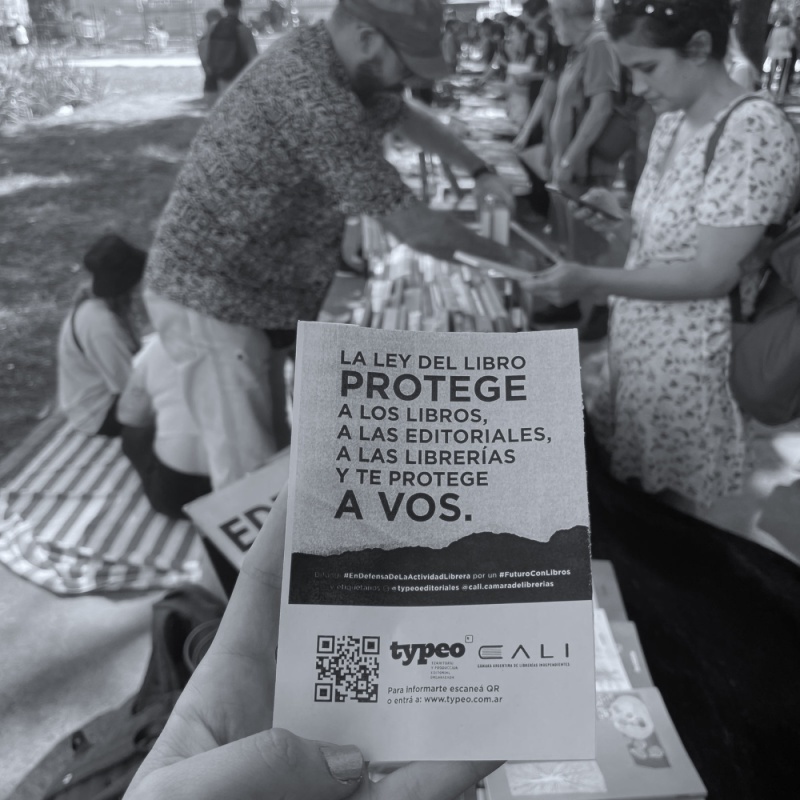
With this precedent in mind, the motivation to start a cooperative was twofold. On the one hand, mutual aid: providing concrete benefits to its members such as buying supplies more cheaply, sharing stands at national or international fairs (which otherwise are financially prohibitive to attend), and facilitating exports. On the other, the political aspect: to form a space for critical reflection regarding our practice as publishers and a common voice to intervene in the policies that regulate the publishing field. Faced with the new political and social situation caused by Milei’s rise to power and the public announcement of his mega-reform, TyPEO soon became a space of organization for its members to resist such attacks and to preserve the Book Law as a means of defending our common existence. From a perspective of trade union knowledge, we understood that this reform negatively affected all relationships in the book value chain. Together with the Chamber of Independent Bookstores (C.A.L.I- Cámara Argentina de Librerías Independientes) and the Union of Writers (U.E.E.A- Unión de Escritoras y Escritores de Argentina), we launched an awareness campaign throughout the territory. Under the flag of “BOOK WORKERS” (“TRABAJADORXS DEL LIBRO”), it consisted of joint mobilization within the framework of the general mobilization against Milei's mega-reform, public statements, and a graphic campaign displayed in almost all independent bookstores in Argentina, in the media, and on social networks. This initiative managed to bring the issue to the forefront of public discussion and broke sectoral isolation. But, above all, it brought representatives from the entire book production chain (publishers, authors, translators, layout artists, designers, proofreaders, booksellers, distributors, etc.) together towards a common goal: showing the power of organization and collective action.
Finally, the proposed amendments were excluded from the mega-reform on June 28, 2024, constituting a great victory of union resistance. Beyond this milestone, the reality of the Argentine publishing industry finds itself in a spiralling crisis as the policies of adjustment, defunding, and economic liberalization of the economy, applied by the occupying government led by Milei, consolidate. The existence of collective spaces that transcend the fleeting, often relentless routine grind of book production, alongside the weaving of networks between in(ter)dependent publishers in a context of atomization and dispossession, are both a relief and a platform from which to reimagine and reconstruct the publishing field once the nightmare ends.
1 The extensive network of public universities and free public education has arguably been the greatest factor in consolidating Argentina’s publishing industry, by fostering a broad reading public.
Ramiro Mases is a Peronist activist and co-founder of the publishing house Rara Avis in Buenos Aires. Together with El Colectivo, Del Signo, Astier, Ubu, Muchas Nueces, Hasta Trilce, La Libre, Cúlmine, Ripio, he initiated the cooperative TyPEO.
***
Support Wirklichkeit Books by buying our books: www.wirklichkeitbooks.com